Architecture
Exterior
Garden
The Position of the Villa
Interior
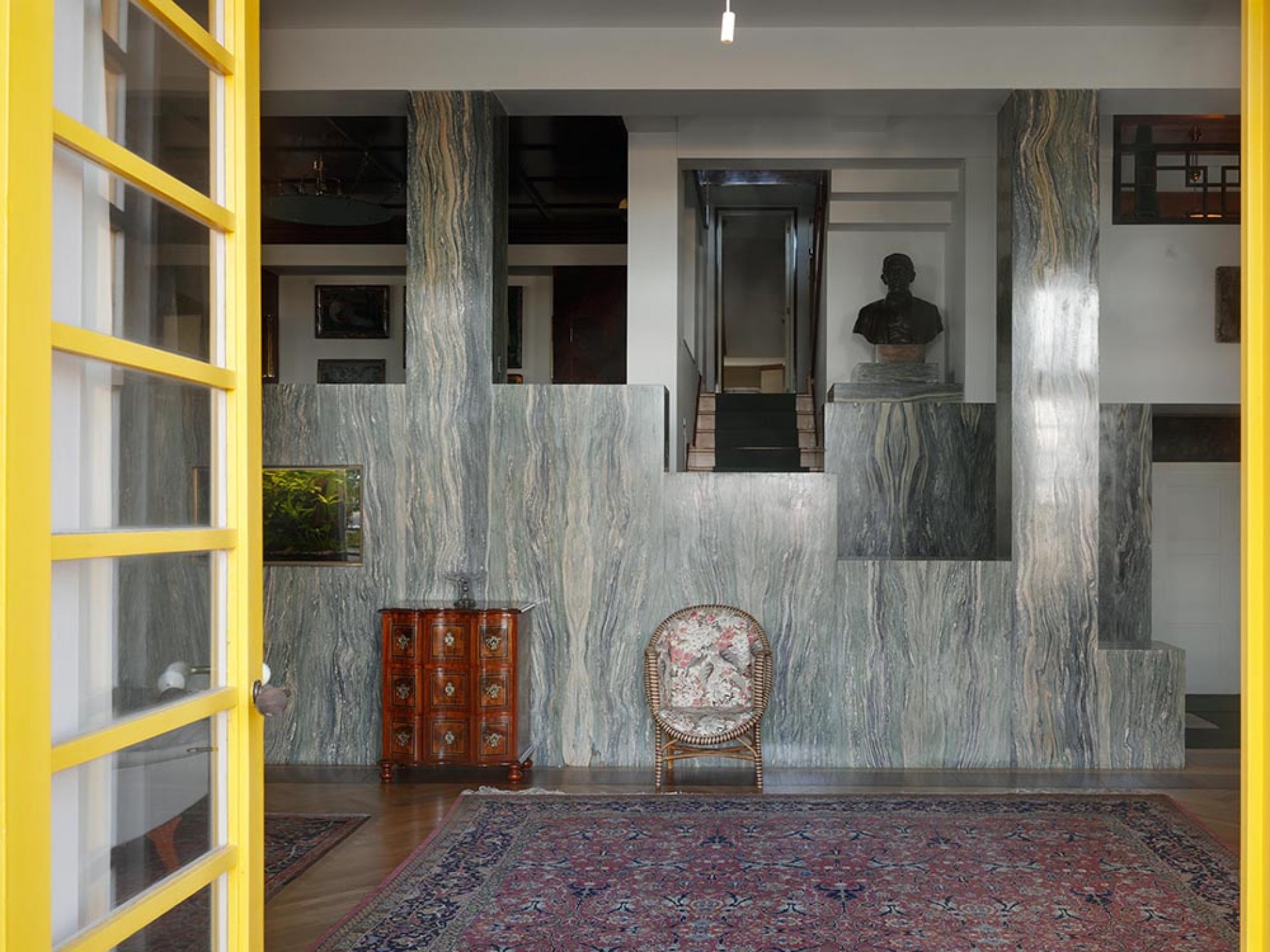
Loos worked creatively with a number of compositional schemes and principles that he considered essential for his work and that were tested by architectural practice. Despite the modern complex interpretations of Loos's ideas of housing, his creative process is very simple. Loos always tried to create a home in which a person would feel comfortable and satisfied. Symmetry, the use of noble materials and the gradation of the heights of individual rooms are characteristic features of Loos' interior work.
Raumplan
Loos's original conception of the interior, the Raumplan (literally 'spatial plan'), put forth a "nnew spatial conception for living spaces, not on a single level (...) according to floors". Its essence lay in the dramatic gradation of levels for individual spaces to match their function or symbolic importance, all composed around a central staircase. Not only does the Raumplan allow for the mutual visual connection of spaces and play with spatial illusions, but it also implies the maximal use of the house's interior volume. The different areas placed at varying horizontal levels are mutually connected by several steps.
Exterior
The basic shape of the villa is a cuboid. The two facades – the entrance and the side, adjacent to the public staircase – surprise with the austerity of large areas of smooth walls with relatively small windows. Both facades have a shallow niche with an entrance inserted at the base – on one side is the entrance to the villa, on the other to the garage. The niches are situated below the level of the road, therefore they are very little visually used. The other two facades have smooth walls generously divided into cubes. On the side closer to Střešovická Street, full parapets cover the terrace by the living room and the balcony on the first floor. The second facade is divided by a bay window and an interesting element of an odd window, which crowns the building at the level of the roof terrace.
The austere character of the facades is typical of Adolf Loos' buildings. The builder Kriegerbeck has preserved for us Loos's interpretation of the concept of the facade: "I never play with the facade, I don't live there. Take a chair, sit in the middle of the street in the rain and look at the facade. When I do a facade on the street, I make a nice ground floor, or I cover the first floor with marble. I leave it bare above the first floor, I can't see there anymore..."
Loos first embodied this credo in 1911 during the construction of the Viennese department store of the Goldmann and Salatsch company, whose facade is covered with marble on the ground floor and bare above the first floor. Similarly, Dr. Müller's villa demonstrates Loos's belief that a house should be built not for passersby, but for its inhabitants.
Garden
The garden of the villa was designed at the same time as the construction of the villa. Its authors were three garden architects: Camillo Schneider (1876–1950), co-author of the castle park in Průhonice and the gardens of the Nostic Palace in Prague, Karl Förster (1874–1970), a garden architect from Potsdam, and Hermann Mattern (1902–1971), a member of the Berlin Academy. The original garden plans were found in the estate of Milada Müllerová, stored in the Museum of Applied Arts in Prague. While studying them, Dr. Božena Pacáková-Hošťálková discovered an analogy between the procedures used in designing the living space of the garden and the living hall space in the house, which is manifested mainly in the recurring colors. Dr. Pacáková-Hošťálková notes: “The green marble of the main hall was replaced by a dark green yew wall outside. The variety of Caucasian, Persian and Afghan carpets was a flower bed. The purple color of the sofa outside was given by iris and phlox flowers, the color of the red brocade of the two-seater by peony flowers, the pink color of the armchair by aster flowers, the gray-green color of the second armchair by fleshy stonecrop leaves, the cover of the third armchair with a floral motif on a light background embodied the variety of the flower bed in general..."
Location of the villa
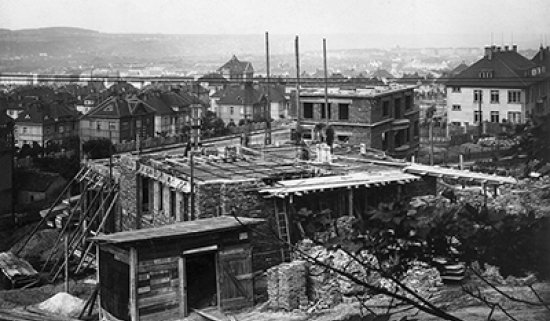
The villa of Dr. Müller was built on a plot of land between Střešovická and Nad Hradním vodojemem streets. The pentagonal-shaped plot has a total area of 1,270 m2 (555 m2 of built-up area, 715 m2 of garden area) and is located on a north-facing slope with an elevation of 11 m. The steepness of the terrain was a significant disadvantage for the construction. The highest part of the plot, adjacent to Nad Hradním vodojemem street and allowing access to the villa, has an altitude of 308.97 m and is located significantly higher than Prague Castle. However, the exceptionally beautiful views over the Vltava valley with Troja Castle to the distant, open horizon and an interesting view of St. Vitus Cathedral offset the disadvantages of the very steep plot.